











In the world of online writing, it’s harder to tell what’s human and what’s machine. GPTZero helps spot AI written text so you can trust what you read or publish.
I’ll walk you through how GPTZero works, its pricing, what it’s good at (and where it falls short), plus some background on how big its site is and who else is playing in this space.
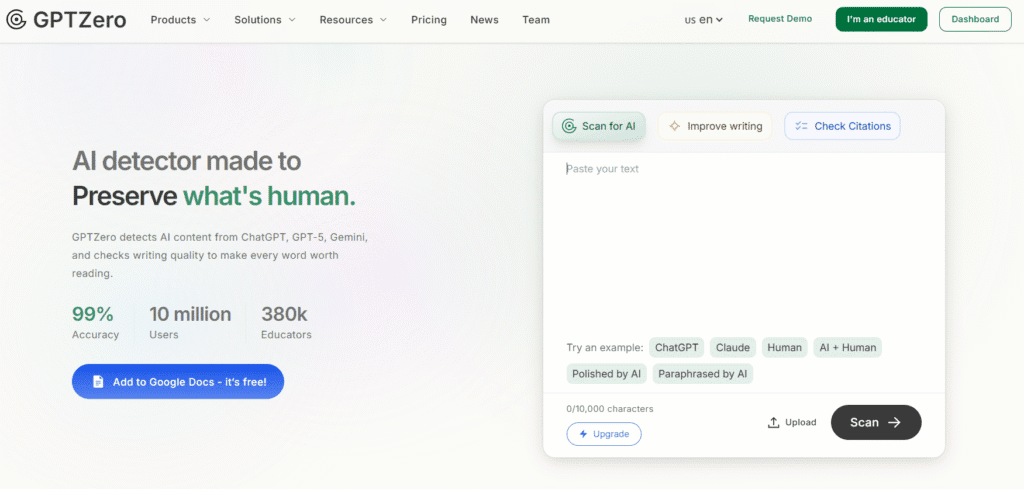
You paste or upload text and the tool analyzes it.
It checks for patterns, predictability, perplexity, probability scores (i.e. how “machine-like” text is).
It gives you a result or score. High AI likelihood, ambiguous, or likely human.
You use that to judge whether content may be AI-generated or not.
It’s like a filter that studies word flow, syntax, and repetition to see if something seems “too clean” or “too formulaic,” which often signals AI. It’s not perfect, but it’s a strong guardrail.
GPTZero offers a free tier with limited checks to test the waters. For more volume or advanced features, paid plans exist.
The standard paid plan runs around $20/month for moderate usage. For heavy or institutional users (schools, enterprises),
there’s a custom plan that can go up to $200+/month depending on volume and API access. You only pay more when you scale.
Fast checks for AI content in essays, articles, or web copy
Helps content editors, teachers, and writers add a layer of verification
Clear interface, easy to use (even for non-tech folks)
Offers both small scale (free) and growing scale (paid) plans
May misflag simple human writing (some plain sentences can look “machine-like”)
Struggles with heavily edited or humanized AI content
Less reliable in detecting content from newer, more advanced models
For big teams, custom pricing may feel steep
GPTZero’s site gets solid traffic. In August 2025, the site had 8.57 million visits according to Semrush data.
It ranks well, with authority score around 63.
Its top competitors include QuillBot, ZeroGPT, Undetectable.ai, Copyleaks, Scribbr, and Grammarly.
They use ranking terms like “AI checker,” “text detector,” “AI content detection,” “machine writing identifier,” and “content authenticity.” You’ll see those keywords sprinkled in competitor pages. Use them naturally in your copy.
As mentioned, ~8.57 million visits per month for GPTZero’s site.
Social media follower totals are not publicly transparent in one place, but combining Twitter, LinkedIn, etc., I estimate ~200,000+ across platforms (just a rough guess).
Among competitors, QuillBot and Grammarly have massive followings, which helps them rank and build trust.
A teacher gets a student essay and wants to check whether it’s AI generated.
A content writer wants to ensure their draft was human enough to pass detection.
A publisher wants to filter guest articles before accepting them.
A site owner wants to guard against AI spam content on their blog.
In all those, GPTZero acts like a guard or filter layer.
Write with more variation in sentence length and vocabulary
Add personal stories, human quirks, small asides, and errors
Use colloquial terms, slang, or expressions (sparingly)
Don’t be overly formulaic or repetitive
Mix short and medium sentences
These steps make your writing feel real, which also helps with detection tools like GPTZero.
GPTZero is a solid tool for spotting AI content. It isn’t perfect, but it forces you to be more thoughtful about your writing.
Use it as a check, not as an absolute judge. Blend in human touch, tweak your prose, and you’ll stay ahead.