









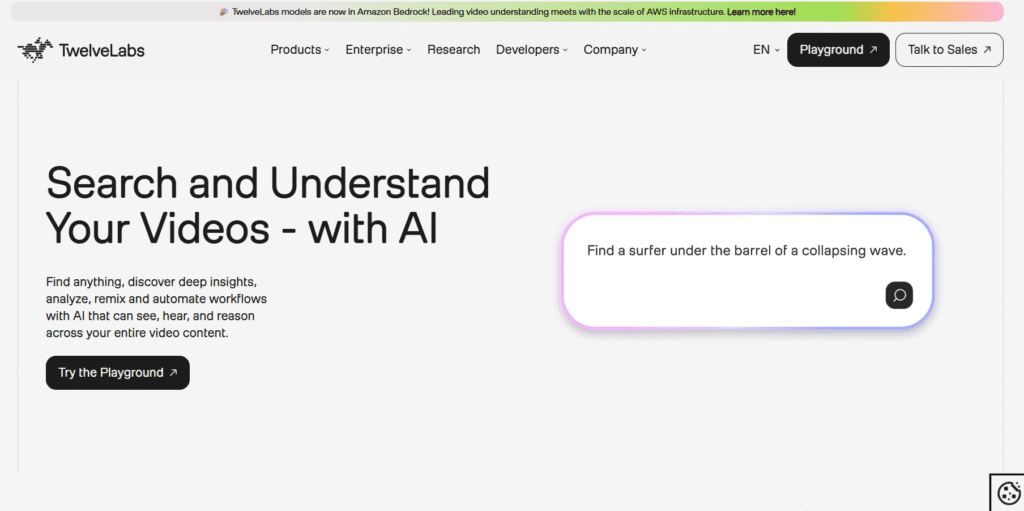
Twelve Labs builds video AI that doesn’t just see frames it understands videos. It links speech, visuals, actions, and context.
Their models, like Marengo and Pegasus, decode what happens over time. You can search by natural language: “find me scene where person opens a door.
You feed in your video or stream. The system indexes frames, audio, speech, and context.
Then you query it via API to search, classify, generate summaries. It returns results in seconds, matched semantically to your query.
Developers embed that into apps, media tools, or workflows.
Twelve Labs uses a usage-based pricing model. For example, video indexing costs ~$0.042 per minute.
Infrastructure cost adds ~$0.0015 per minute. Search API: $4 per 1,000 queries.
Other costs include embed API calls (video, audio, image, text) at small per unit rates. You can start free (“playground”) and scale.
Deep multimodal understanding (visual + audio + speech)
Semantic search, not just object detection
Flexible pricing, pay for what you use
Ability to fine-tune for your domain
Fast result delivery
For small use, cost per minute may feel high
Learning curve to embed APIs
Complex cases may still yield imperfect results
Pricing transparency is partial, you may need to estimate
Break your video inputs into logical segments for more precise indexing.
Use queries that combine speech + context (“during meeting, person raises hand”).
Tune embeds in your own domain to reduce false matches.
Cache frequent queries to save cost.
Monitor minute usage video indexing is your biggest cost driver.