











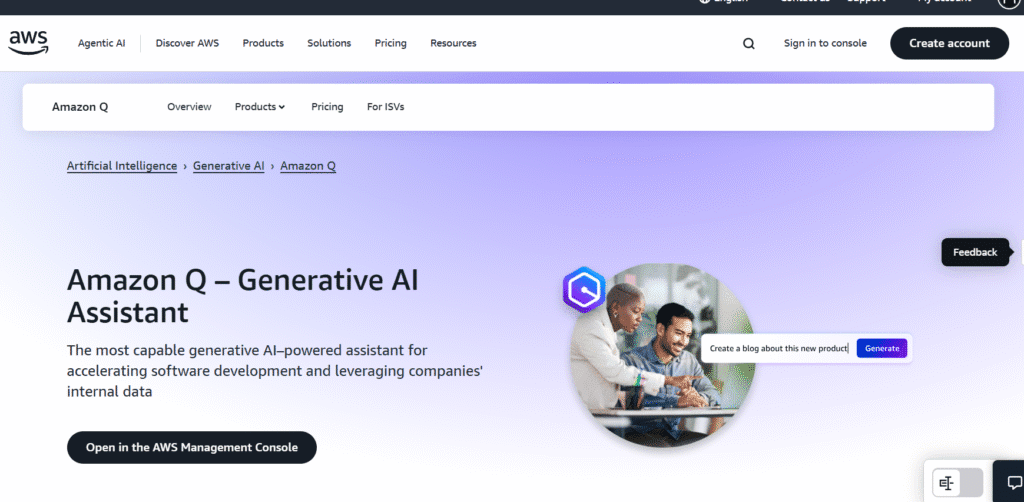
Amazon Q is a generative AI assistant by AWS designed for business and developer use.
It taps into your company’s data, systems, and tools to answer, generate, or act.
It’s not just chat it connects with real enterprise sources for context.
It splits into Q Business, Q Developer, and integrations with QuickSight & Connect.
So business users, analytics folks, and coders all get their lane.
Natural language queries over data
You ask questions like “sales trend last quarter” or “fix this error” Q responds using your real datasets
Q Developer can go beyond suggestions it can generate, refactor, test, and review code.
Embedded in AWS & apps
It works inside AWS Console, Slack, Teams, Outlook, etc. You don’t bounce around.
Indexing & connectors
You link your docs, databases, or tools via connectors so Q uses your actual data.
Hallucination mitigation & guardrails
It has systems to reduce “made up” answers, and you can constrain where it draws data from.
Here’s how costs break down (in AWS terms, in USD):
Q Business Lite: ~$3 per user/month. Basic Q chat over enterprise data.
Q Business Pro: ~$20 per user/month. Adds Q Apps, extended responses, plugin support.
QuickSight + Q: For analytics, Q in QuickSight has Author / Pro tiers: ~$24/month for Author, $50/month Author Pro.
Q Developer: Free Tier (50 agentic chat requests + 1,000 lines of code/month). Pro version: $19/month.
Consumption pricing: For Q in Connect (contact center), ~$0.0015 per chat message, ~$0.008 per voice minute.
Also note: there is a $250/month “Q enablement fee” per account when using Q in QuickSight with Pro or topics.
So for example if you have 100 Pro users, 1 index, Q Apps, and analytics features—you’re easily into thousands a month.
Deep integration with AWS & enterprise systems.
Strong context: uses real business data not generic web.
Helps both non tech and dev teams in one platform.
Advanced capabilities: coding, dashboards, plugin actions.
Fine control via guardrails and connectors safer responses.
Cost can balloon for many users or heavy usage.
It may struggle with unusual or unconnected data.
Some accuracy issues reported (internal review flagged Q behind rivals on accuracy)
Learning curve: setting up indices, connectors, permissions.
Dependence on AWS ecosystem less portable outside AWS.
A business analyst asks Q: “Show me top product category growth this month.”
A dev asks Q Developer: “Refactor this module and add tests.”
A support center: Q in Connect suggests responses or solutions in chat.
A team: build a Q App that automates report generation or approval workflows.
In QuickSight: ask Q “Create dashboard of customer churn trends.”
Exact monthly visitors for the “Amazon Q” product page aren’t publicly published. But AWS brand domains often hit tens millions of monthly visitors.
As for social media, AWS & Amazon collectively have tens of millions of followers across platforms.
A single number: ~25 million+ followers across LinkedIn, X, YouTube, etc. (estimate based on AWS + Amazon presence).
Amazon Q is AWS’s big push into workplace AI. It bridges analytics, coding, chat, and enterprise data in one assistant.
For companies deep in AWS, it’s compelling. For others, the lock-in and cost may be barriers.
If you build content around its features, pricing tiers, use cases, and real value and use those natural LSI phrases above you’ll be positioned to attract users looking for generative AI in enterprise.