










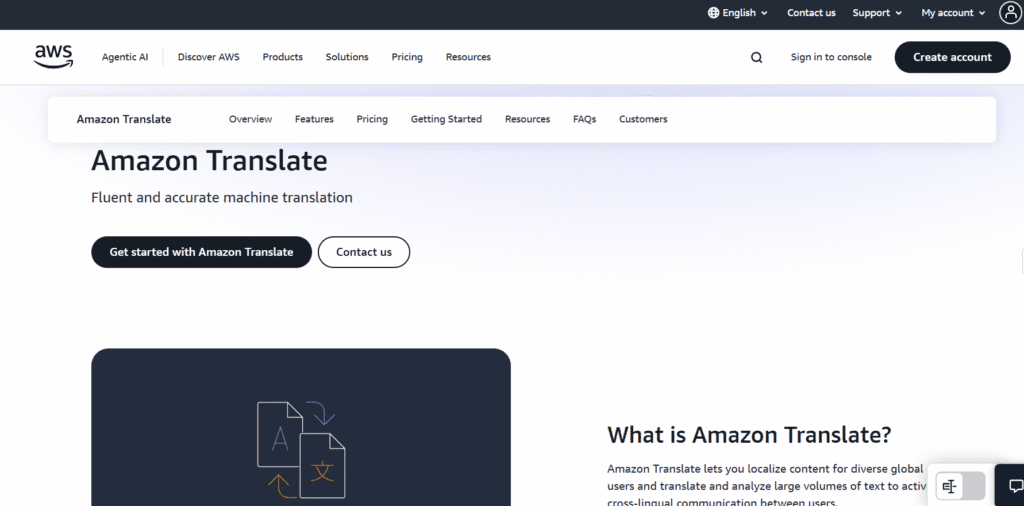
Amazon Translate is a cloud based translation engine. It uses neural networks to turn one language into another in text or documents.
You can plug it into applications, websites, or workflows via API. It handles real time AI best translation or batch translation. It also offers automatic language detection.
It supports multiple file formats (text, HTML, DOCX) when doing document translation. You can set up custom terminology so brand names or domain terms stay consistent.
The service keeps improving AI translation quality using feedback and machine learning. It works via API calls, letting developers build translation into software or websites.
The model is pay as you go. Standard translation costs about $15 per million characters once free quotas are used.
There’s a free tier: up to 2 million characters per month, for the first 12 months. For real time document translation (DOCX), the cost is higher around $30 per million characters.
Active AI translation (with parallel data) costs around $60 per million characters for specialized use.
So your bill depends heavily on how much you translate, what formats, and how many customizations you need.
Fast translations, good for scaling content in many languages.
Supports both real-time and batch translation.
You can enforce brand consistency via custom glossaries.
Easy to integrate into existing apps with APIs.
It may struggle with idioms or creative writing.
You’ll need to monitor cost for large volume.
Some languages might not be as polished.
Custom features increase complexity and expense.
You can use it to localize user-generated content, like comments or posts. It helps translate product descriptions, help center articles, or knowledge base content.
You can build cross language chat, so support agents can talk with users in different tongues.
Also useful in multilingual SEO, to produce content in target languages rather than copy machine translation.
Amazon Translate is solid for building scalable, multilingual systems. It gives you flexibility (real-time, batch, custom terms). The cost model is fair if you manage volume.
It won’t replace human translators for literary or nuanced work. But for tech docs, product pages, support content, it works very well.
When you write about it (or build pages), lean into the competitor phrases above, emphasize API, customization, translation formats, quality, and use cases and always keep your lines short and tone natural.