











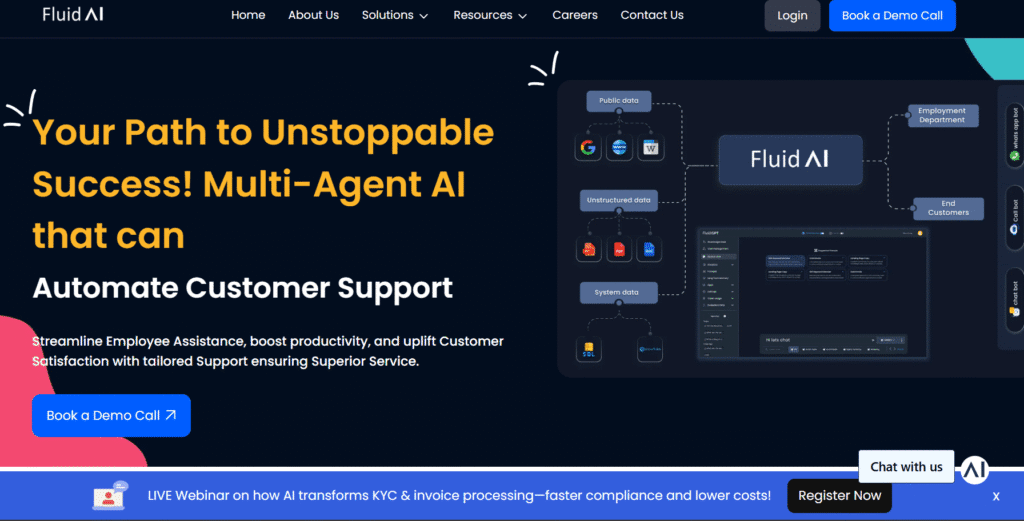
Fluid AI is built for enterprises to convert manual work into AI agents. It helps teams automate workflows, retrieve data smartly, and produce humanlike interactions fast.
It supports voice, chat, APIs, and can be deployed in cloud, hybrid, or on-prem setups. Its focus is on reducing error, boosting speed, and lowering operational burden.
Fluid AI tool lets you spin up multiple agents that coordinate. One agent plans, another executes, another monitors. They talk to each other.
This gives more flexible, modular automation than a monolithic bot.
It doesn’t just fetch info it reasons. It retrieves context, validates sources, and can adjust responses dynamically.
That means fewer hallucinations, more grounded answers.
Every output comes with source snippets or validation scores. You see where info came from. This transparency builds trust in AI tool outputs.
You don’t start from scratch. It gives you templates, workflows, and integrations (Slack, WhatsApp, CRMs).
That cuts time from concept to launch.
You can host fully inside your cloud, hybrid, or use their secure cloud. Data isolation, encryption, access controls are in place.
Fluid AI plugs into APIs, databases, legacy systems easily. As demand grows, it scales forward.
Fluid AI doesn’t publicly list a simple “monthly plan” option. Their pricing is based on scale, features, number of agents, and deployment choices.
For small to mid teams, a base tier might cost a few thousand dollars per month, while full enterprise use with private hosting and large scale workflows could reach tens of thousands monthly.
They tend to negotiate based on use case, volume, and support needs.
Across cases, Fluid AI claims you can deploy in ~60 days.
Fluid AI is strong where you need serious scale, precision, and trust in your AI systems. It’s not just a chatbot it’s a whole orchestration of agents.
If you’re tackling complex workflows and data, it fits well. If your needs are light or cost sensitive, you may find overhead heavy.