

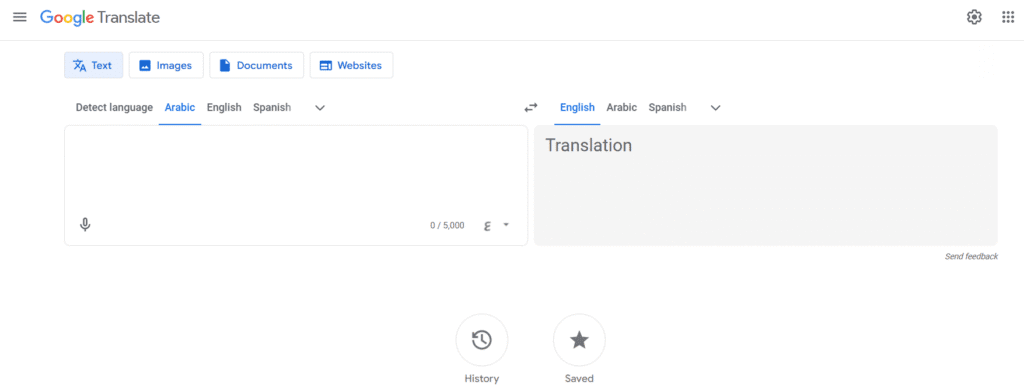
Google Translate is a neural machine translation service by Google.
It helps convert text, speech, images, or entire documents into another language.
It supports over 100+ languages and works on web, mobile, and via API.
It’s widely used daily by millions around the world.
Google Translate handles 146 billion words daily across its services.
The web version, translate.google.com, sees ~598.0 million visits/month in recent data.
That massive volume shows how many people use it as their default translation tool.
Because it’s often free (for casual users), adoption is huge. It’s baked into browsers, apps, and many workflows.
Type or paste text and get instant translation. Speak in one language, get translation in another.
It uses context to translate better, not just word-by-word.
You can upload docs (like .docx, .pdf) for translation. You can translate websites by pasting URL or using embed. It handles layout preservation in many cases.
Use your phone camera to scan signs, menus, labels, etc. It recognizes text in images and gives translation in real time. Very handy while traveling.
You can download language packs to translate offline. That means even without internet, basic translation still works.
Useful when you’re abroad or have spotty signal.
There’s a Cloud Translation API. You can plug it into apps or sites. It charges by characters translated, with free quotas for light use.
Developers can also build custom translation models and adapt output.
For casual users, Google Translate is mostly free.
With the API: first 500,000 translated characters per month are free (via credit).
Past that, it’s ~$20 per million characters for many translation tasks.
Document translation costs ~$0.08 per page.
If you train a custom model, cost is ~$45/hour (capped per job) for that training.
Instant translation across many languages
Multiple input types (text, voice, image, document)
Offline support for many languages
Integration via API for developers
Sometimes loses nuance, idioms, tone
For highly technical or legal text, errors may creep
Premium / heavy usage costs add up
Privacy risk: translated texts may go through Google’s servers
Google Translate supports 100+ languages (and growing).
It includes major ones like English, Spanish, Arabic, Chinese, Hindi, and many local / minority languages.
Some pairs or dialects have better quality; rare ones may be less polished.
Google Translate is a powerful, accessible AI tool for bridging language gaps.
Its free features serve most users well.
For developers and heavy users, the API pricing gives flexibility.
It’s not perfect subtle meaning or tone can slip but it’s a dependable backbone for many AI smart translation needs.